WordPress rebuild and structured content system
A new WordPress site built so a non-technical team can publish articles, ebooks and webinars through structured content, with lead forms connected to the CRM the client already used.
- Period
- 2026
- Context
- Professional work
- Client
- Undisclosed
Context
The client needed a new website that modernized the existing experience while remaining practical for their internal team to maintain.
The site was built from scratch in WordPress on a staging environment. Alongside implementing the supplied visual design, I needed to create a content structure that allowed the team to publish articles, ebooks and webinars without rebuilding layouts or working directly with page-builder blocks.
- Platform
- WordPress
- Build
- New website from scratch
- Content
- Blog · Ebooks · Webinars
- Status
- Live in production
The challenge
The main challenge was separating the editing experience from the frontend presentation.
The client needed simple interfaces with only the fields required for each type of content, while the public website still had to maintain a consistent responsive design. The rebuild also had to accommodate existing blog content, different webinar states, ebook downloads and lead capture without making the editorial workflow more complex.
What I was responsible for
Frontend implementation
- Built the responsive website in WordPress using Astra, a child theme and Spectra, translating the supplied desktop design across screen sizes.
Content architecture
- Created dedicated content types and ACF editing interfaces for Blog, Ebooks and Webinars so the client could manage content without editing layouts.
Templates and migration
- Connected structured fields to reusable templates and content loops, and migrated 158 existing blog posts from the previous WordPress website.
Forms and lead delivery
- Implemented Gravity Forms flows connected to the client’s existing Zoho CRM and validated them against the configuration the client specified, including the ebook download journey and authenticated email delivery.
Solution
I built the new site around a structured WordPress content model instead of asking the client to recreate page layouts every time they published something.
Each main resource type has its own editing experience. Editors provide the content and metadata required for that resource, while reusable templates and loops control how it appears on the frontend.
This approach allowed the website to preserve the supplied visual system while keeping the day-to-day publishing workflow much simpler for the client.
Forms were connected to Zoho CRM so relevant leads could move directly into the client’s existing lead-management process.
Technical approach
Build foundation
Set up the WordPress implementation with Astra, a child theme and Spectra, then reproduce the supplied design responsively.
Model content
Define dedicated content types and structured ACF fields for the different resource formats.
Create templates
Connect the content fields to reusable frontend templates and loops so entries inherit the correct presentation automatically.
Migrate
Import 158 existing blog posts and adapt them to the new content and template structure.
Connect leads
Route relevant Gravity Forms submissions into Zoho CRM for the client’s lead-management workflow.
Deliver content
Use the selected resource and submitted form data to support flows such as ebook delivery by email.
The system
- Choose what arrives to run it.
A content editor works through structured fields rather than page layouts. Those fields belong to one content model, which defines three separate content types: blog articles, ebooks and webinars. All three converge on the same reusable templates and content loops, which render them on the responsive frontend. New entries therefore inherit the correct presentation without anyone rebuilding a layout.
Structured content
Blog
Articles are managed as structured entries and rendered through reusable archive and single-content templates.
Editorial fields
- Title
- Category
- Featured image
- Excerpt
- Article body
Ebooks
Ebooks combine structured metadata with an uploaded file that can be used by the download and lead-capture flow.
Editorial fields
- Title
- Featured image
- Description
- Number of pages
- File
Webinars
Webinar entries use structured event data and a status field to adapt the frontend between upcoming registration and recorded content.
Editorial fields
- Title
- Image
- Status: Upcoming or Recorded
- Description
- Date
- Time
- URL
Ebook lead flow
The ebook library is connected to a reusable lead-capture flow rather than a separate form for every resource.
When a user requests an ebook, the form carries the context of the selected resource through submission. The lead is sent into Zoho CRM, the corresponding file is delivered by email and the popup transitions to a confirmation state.
Requesting an ebook opens one reusable lead form rather than a separate form for each resource, and the selected resource travels with the request. A successful submission produces three independent results: the lead is recorded in the client’s CRM for their existing lead-management process, the corresponding file is sent to the user by email, and the popup moves to a confirmation state. None of the three waits on any of the others.
Migration and launch
The rebuild also included migrating 158 existing blog posts from the previous WordPress website into the new structure.
Reusable templates allowed the imported content to adopt the new presentation consistently instead of requiring every article to be rebuilt manually.
The new website was completed, presented to the client and approved, and it is now live.
Outcome
The new website is live, with a responsive frontend and structured publishing workflows for the client’s main resource types.
The editorial setup allows the team to add new articles, ebooks and webinars through focused content fields while reusable templates handle the frontend presentation automatically.
Lessons learned
This project gave me much more practical experience designing content architecture in WordPress rather than treating every page as an isolated layout.
Working with custom post types and ACF helped me understand how much the editor experience matters when a website will be maintained by a non-technical team. Separating structured content from presentation made the system easier to keep consistent as new resources are added.
The migration also gave me experience adapting existing content to a new frontend system, while the ebook and CRM flows expanded my work with Gravity Forms, dynamic content and lead delivery.
Technologies
More of my work
All projects- 01 · Client workMulti-hotel reservation data, consolidated for reportingReservation data from twelve hotels depended on monthly lists reviewed by hand, so the workflow brings reservations in continuously and keeps one consistent, historical dataset for client reporting.View project
- 02 · Client workMulti-step form and API integrationA two-step form had to check vehicle eligibility against an external service, turn each response into a clear result state, and carry campaign attribution through to submission.View project
- 03 · Client workInteractive golf club finder and enrollment flowA seasonal campaign needed one enrollment flow for multiple clubs, each with availability rules set by the client, so that every lead reached the right club with the right next step.View project
Open to integration, automation and technical implementation roles.
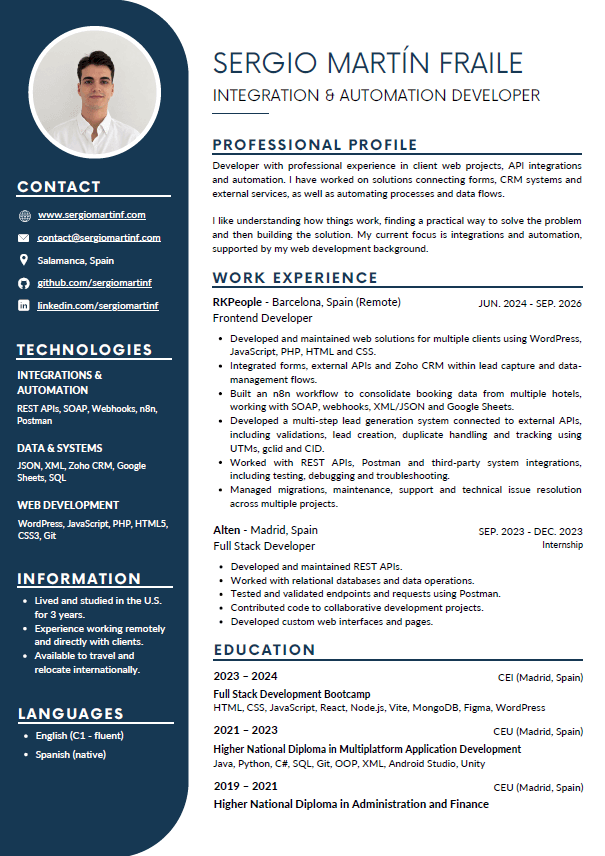
CV
A concise overview of my experience and work.
Email
The best way to reach me about a role.
LinkedIn
Experience, background and professional updates.
GitHub
Selected code, experiments and technical work.